Consider
the following STATA output from data on Major League Baseball salaries. We
regress lsalary (the log of salary in dollars) on the explanatory variables
years (years in the league), gamesyr (the games played per year), rbisyr and
hrunsyr (the RBIs and home runs per year, respectively).
![Source I SS 353 Model 308.574038 Residual 1 183.601497 df MS Number of obs F(4, 348) = 4 77.1435096 Prob > F = 348 .527590508 R-squared Adj R-squared = 352 1.39822595 Root MSE = 146.22 0.0000 0.6270 0.6227 .72635 Total 492.175535 lsalary | Coef . Std. Err t Plt ! (95% Conf. Interval] years I .0692793.0121017 5.72 0.000 gamesуr 1.0123486 .002636 4.68 0.000 hrunsyr I.0109998.0155795 0.71 0.481 rbisyr 1.0124563 .006915 1.80 0.073 cons 11.42672 1166412 97.96 0.000 .0454776 .093081 .0071642 .0175331 - 019642 .0416416 -.0011441 .0260566 11.1973111.65613](https://d2vlcm61l7u1fs.cloudfront.net/media%2Fbdd%2Fbdd100a8-c265-4c24-9152-25bef5215518%2FphprMwW6W.png)
(a)
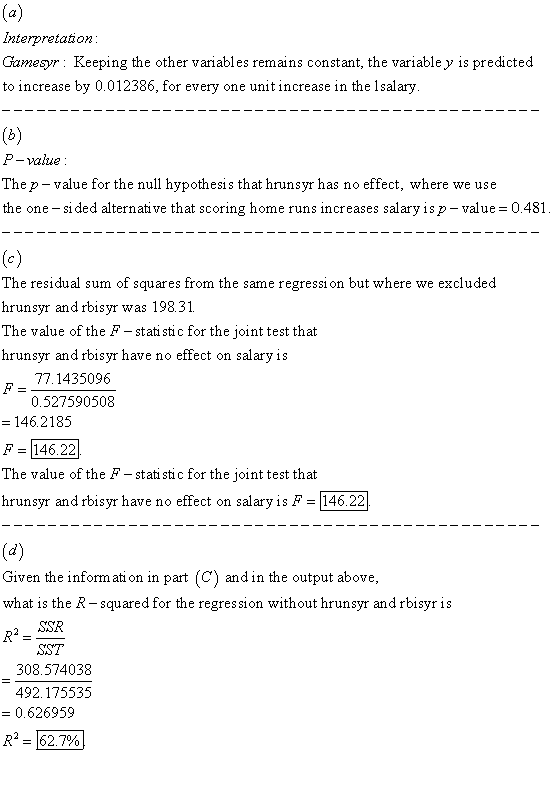
What is the interpretation of the gamesyr coefficient here?
(b)
What is the p-value for the null hypothesis that hrunsyr has no effect, where
we use the one-sided alternative that scoring home runs increases salary.
(c)
Suppose that you were informed that the residual sum of squares from the same
regression but where we excluded hrunsyr and rbisyr was 198.31. What is the
value of the F-statistic for the joint test that hrunsyr and rbisyr have no
effect on salary? (
d) Given the
information in part (C) and in the output above, what is the R-squared for the
regression without hrunsyr and rbisyr?
ANSWER
https://www.chegg.com/homework-help/simply-supported-wood-beam-ab-span-length-l-4-m-carries-unif-chapter-5.5-problem-4p-solution-9780534553975-exc
ReplyDeletehttps://www.chegg.com/homework-help/fiberglass-pipe-lifted-sling-shown-figure-outer-diameter-pip-chapter-5.5-problem-11p-solution-9781285225784-exc
https://www.chegg.com/homework-help/determine-maximum-tensile-stress-t-maximum-compressive-stres-chapter-5.5-problem-16p-solution-9781111577735-exc
https://www.chegg.com/homework-help/spokes-large-flywheel-modeled-beams-fixed-one-end-loaded-for-chapter-5.7-problem-4p-solution-9780534553975-exc
https://www.chegg.com/homework-help/cantilever-beam-length-l-2-m-supports-load-p-80-kn-see-figur-chapter-5.8-problem-4p-solution-9781111577735-exc
https://www.chegg.com/homework-help/mechanics-of-materials-9th-edition-chapter-5.9-problem-3p-solution-9781337093347
https://www.chegg.com/homework-help/mechanics-of-materials-9th-edition-chapter-7.2-problem-3p-solution-9781337093347
https://www.chegg.com/homework-help/mechanics-of-materials-9th-edition-chapter-7.2-problem-15p-solution-9781337093347
https://www.chegg.com/homework-help/mechanics-of-materials-9th-edition-chapter-7.4-problem-13p-solution-9781337093347
https://www.chegg.com/homework-help/solving-problems-section-82-assume-given-radius-diameter-ins-chapter-8.2-problem-3p-solution-9781111577735-exc
https://www.chegg.com/homework-help/solving-problems-section-83-assume-given-radius-diameter-ins-chapter-8.3-problem-5p-solution-9781285225784-exc
https://www.chegg.com/homework-help/mechanics-of-materials-9th-edition-chapter-8.5-problem-14p-solution-9781337093347
https://www.chegg.com/homework-help/questions-and-answers/gaap-require-amortization-goodwill-net-income-goodwill-decrease--maybe-ifrs-goodwill-writt-q16842979
ReplyDeletehttps://www.chegg.com/homework-help/questions-and-answers/accounting-apter-6-homework-questions-3-5-8-following-information-applies-questions-displa-q30071983?trackid=3b8c43b5c011&strackid=776d5a8ec6c3&ii=1&event=click_submit
ReplyDeletehttps://www.chegg.com/homework-help/introduction-to-mathematical-statistics-7th-edition-solutions-9780321849434?trackid=045f086f0f12&strackid=de84a21b28a6&ii=1
ReplyDelete