
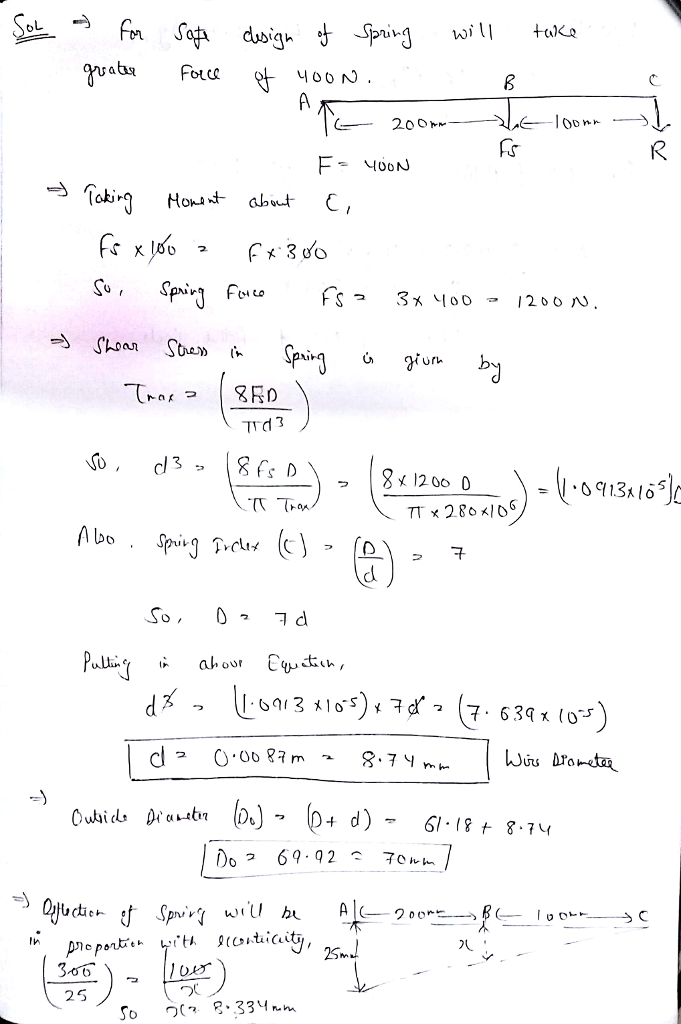
Question: 7. A circular cam 200 mm in diameter rotates off centre with an eccentricity of 25 mm and operates the roller follower that is carried by the arm as shown in Fig. 23.35. ???200 mm +100mm- Spring 25 mm Fig. 23.35 The roller follower is held against the cam by means of an extension spring. Assuming that the force between the follower and the cam is approximately 250 N at the low position and 400 N at the high position. If the spring index is 7, find the diameter of wire, outside diameter of spring and the number of active coils. The maximum shear stress may be taken as 280 MPa. Use G 80 kN/mm2


ANSWER
Comments

  1. https://www.chegg.com/homework-help/questions-and-answers/question-three-32-marks-ighty-two-82-foreign-exchange-students-germany-arrived-namibia-tak-q34837516

    ReplyDelete

  2. What voltage must be applied to a molybdenum-target tube in order that ... - Chegg
    Study app · Installed

    ReplyDelete
  3. https://www.chegg.com/homework-help/questions-and-answers/voltage-must-applied-molybdenum-target-tube-order-emitted-x-rays-excite-k-fluorescent-radi-q21847781

    ReplyDelete

Post a Comment

Popular posts from this blog

Question: prove by induction 2^2 + 4^2 + 6^2 + ... + (2n)^2 = (2n)(2n+1)(2n+2)/6 ANSWER we will use induction on n base case : n=1 we have, 2^2 = 2*3*4/6 = 4 which is true inductive hypothesis let it be true for n = k i.e.,  2^2 + 4^2 + ... + (2k)^2 =   [(2k)(2k+1)(2k+2)]/6 inductive case let n = k+1 then we have 2^2 + 4^2 + .... + (2k)^2 + (2(k+1))^2 =   [(2k)(2k+1)(2k+2)]/6 + (2k+2)^2 =(2k+2)*[(2k)(2k+1)/6 + (2k+2)] =(2k+2)*[ (4k^2+2k)/6 + (12k + 12)/6 ] =(2k+2)*[ (4k^2+14k+12)/6 ] = =(2k+2)*[(2k)(2k+1)/6 + (2k+2)] =(2k+2)*[ (4k^2+2k)/6 + (12k + 12)/6 ] =(2k+2)*[ (4k^2+14k+12)/6 ] = (2k+2)*[ (4k^2 + 8k + 6k + 12)/6 ] = (2k+2)*[ (4k(k + 2) +6(k+2))/6 ] = (2k+2)*[ (4k+6)(k+2)/6 ] =  (2k+2)*[ 2 (2k+3)(k+2)/6  ] =   (2k+2)*[  (2k+3)*2*(k+2)/6  ] =   (2k+2)*[  (2k+3)(2k+4)/6  ] = [(2*(k+1))(2*(k+1)+1)(2*(k+1)+2)]/6 replacing k+1 by m, we get replacing k+1 by m, we get [(2*m)(2*m+1)(2*m+2)]/6 this completes our proof b...

IT management

FIGURE P1.1 The File Structure for Problems 1-4 1.       How many records does the file contain? How many fields are there per record? 2.       What problem would you encounter if you wanted to produce a listing by city? How would you solve this problem by altering the file structure? 3.       If you wanted to produce a listing of the file contents by last name, area code, city, state, or zip code, how would you alter the file structure? 4.       What data redundancies do you detect? How could those redundancies lead to anomalies? Figure P2.4 The DealCo relational diagram 4. Identify each relationship type and write all of the business rules. 5.       Create the basic Crow’s Foot ERD for DealCo. FIGURE P3.17 The Ch03_TransCo Database Tables     17. For each table, identify the primary key and the for...
Question: Q1 a. Sketch the static characteristics of a diode. (6 marks) b. An AC voltage source V drives a transformer with centre tap second indin gs connected to two rectifiers is shown in the following diagram. The load has constant current Io. Assume that when the diode conducts the forward voltage drop is Ve d V Vmsnot. The turns ratio is N: 1:1. Sketch the current waveform through one of the diodes. (6 marks) c. Write down an equation for efficiency of a power converter in terms of output power and converter losses (2 marks) d. Given the following parameters, calculate the efficiency of the power converter. Va = 310 V ω-2π50 forward voltage drop of the diodes VF = 0.7 V Transformer turns ratio = 10: 1 : 1 load current = 10 A Assume that the transformer has no loss and converter losses come from the diodes only. Also assume the diode voltage drop does not change with current. State your assumption if there is any 6 marks) ANSWER