
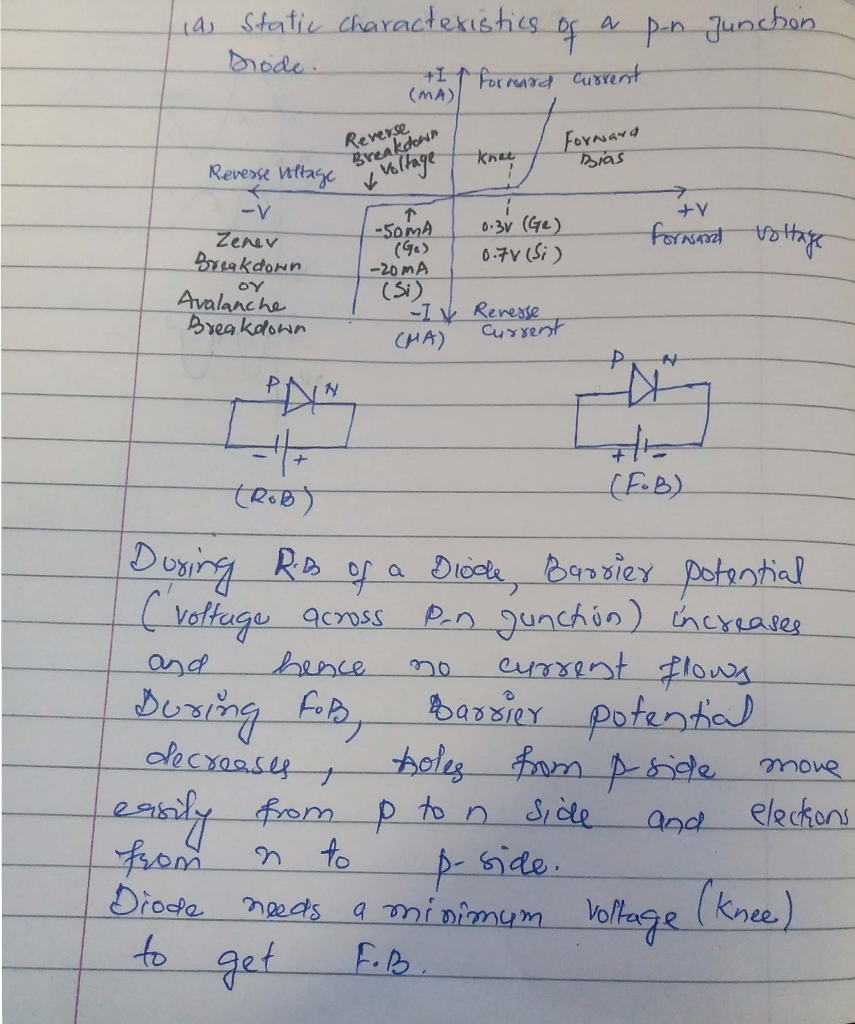
Question: Q1 a. Sketch the static characteristics of a diode. (6 marks) b. An AC voltage source V drives a transformer with centre tap second indin gs connected to two rectifiers is shown in the following diagram. The load has constant current Io. Assume that when the diode conducts the forward voltage drop is Ve d V Vmsnot. The turns ratio is N: 1:1. Sketch the current waveform through one of the diodes. (6 marks) c. Write down an equation for efficiency of a power converter in terms of output power and converter losses (2 marks) d. Given the following parameters, calculate the efficiency of the power converter. Va = 310 V ω-2π50 forward voltage drop of the diodes VF = 0.7 V Transformer turns ratio = 10: 1 : 1 load current = 10 A Assume that the transformer has no loss and converter losses come from the diodes only. Also assume the diode voltage drop does not change with current. State your assumption if there is any 6 marks)


ANSWER
Comments

  1. https://www.chegg.com/homework-help/questions-and-answers/differential-brake-band-trigonometry-question-find-distances-bottom-2597-8810-7939--q11904593

    ReplyDelete
  2. https://www.chegg.com/homework-help/questions-and-answers/describe-difference-objects-values-using-terms-equivalent-identical-llustrate-difference-u-q35630655

    ReplyDelete
  3. https://www.chegg.com/homework-help/questions-and-answers/7-would-considered-investment-context-national-income-accounting-according-economists--pur-q17081067

    ReplyDelete

Post a Comment

Popular posts from this blog

Need answers for your academic questions?

Need answers for your academic questions? Ask them in the comment section below. Just type in the url link of your question in the comment section below. And get your answer ready in two formats. Hand written Screenshot We will post the answer as soon as we get them (questions) Thank you..
Question: prove by induction 2^2 + 4^2 + 6^2 + ... + (2n)^2 = (2n)(2n+1)(2n+2)/6 ANSWER we will use induction on n base case : n=1 we have, 2^2 = 2*3*4/6 = 4 which is true inductive hypothesis let it be true for n = k i.e.,  2^2 + 4^2 + ... + (2k)^2 =   [(2k)(2k+1)(2k+2)]/6 inductive case let n = k+1 then we have 2^2 + 4^2 + .... + (2k)^2 + (2(k+1))^2 =   [(2k)(2k+1)(2k+2)]/6 + (2k+2)^2 =(2k+2)*[(2k)(2k+1)/6 + (2k+2)] =(2k+2)*[ (4k^2+2k)/6 + (12k + 12)/6 ] =(2k+2)*[ (4k^2+14k+12)/6 ] = =(2k+2)*[(2k)(2k+1)/6 + (2k+2)] =(2k+2)*[ (4k^2+2k)/6 + (12k + 12)/6 ] =(2k+2)*[ (4k^2+14k+12)/6 ] = (2k+2)*[ (4k^2 + 8k + 6k + 12)/6 ] = (2k+2)*[ (4k(k + 2) +6(k+2))/6 ] = (2k+2)*[ (4k+6)(k+2)/6 ] =  (2k+2)*[ 2 (2k+3)(k+2)/6  ] =   (2k+2)*[  (2k+3)*2*(k+2)/6  ] =   (2k+2)*[  (2k+3)(2k+4)/6  ] = [(2*(k+1))(2*(k+1)+1)(2*(k+1)+2)]/6 replacing k+1 by m, we get replacing k+1 by m, we get [(2*m)(2*m+1)(2*m+2)]/6 this completes our proof b...

Get assignments and case studies solved...

Hey Guys! Checkout our new site, https://caseaments.blogspot.com/  , where you can get your assignments done at low rate. Just send us the assignment topic. Specify, what you all need, summary or step by step writing. Give us a dead-line and length of assignment. ( number of words) On the basis of that, you will be charged. Any subject, even you can send us case studies , and get them answered. Payment methods: PayPal Payoneer Mail us at earnwithmetoo@gmail.com with the above details for quick response. Or else, join Hangouts . email-id  earnwithmetoo@gmail.com